Ask the graph — browser graphRAG
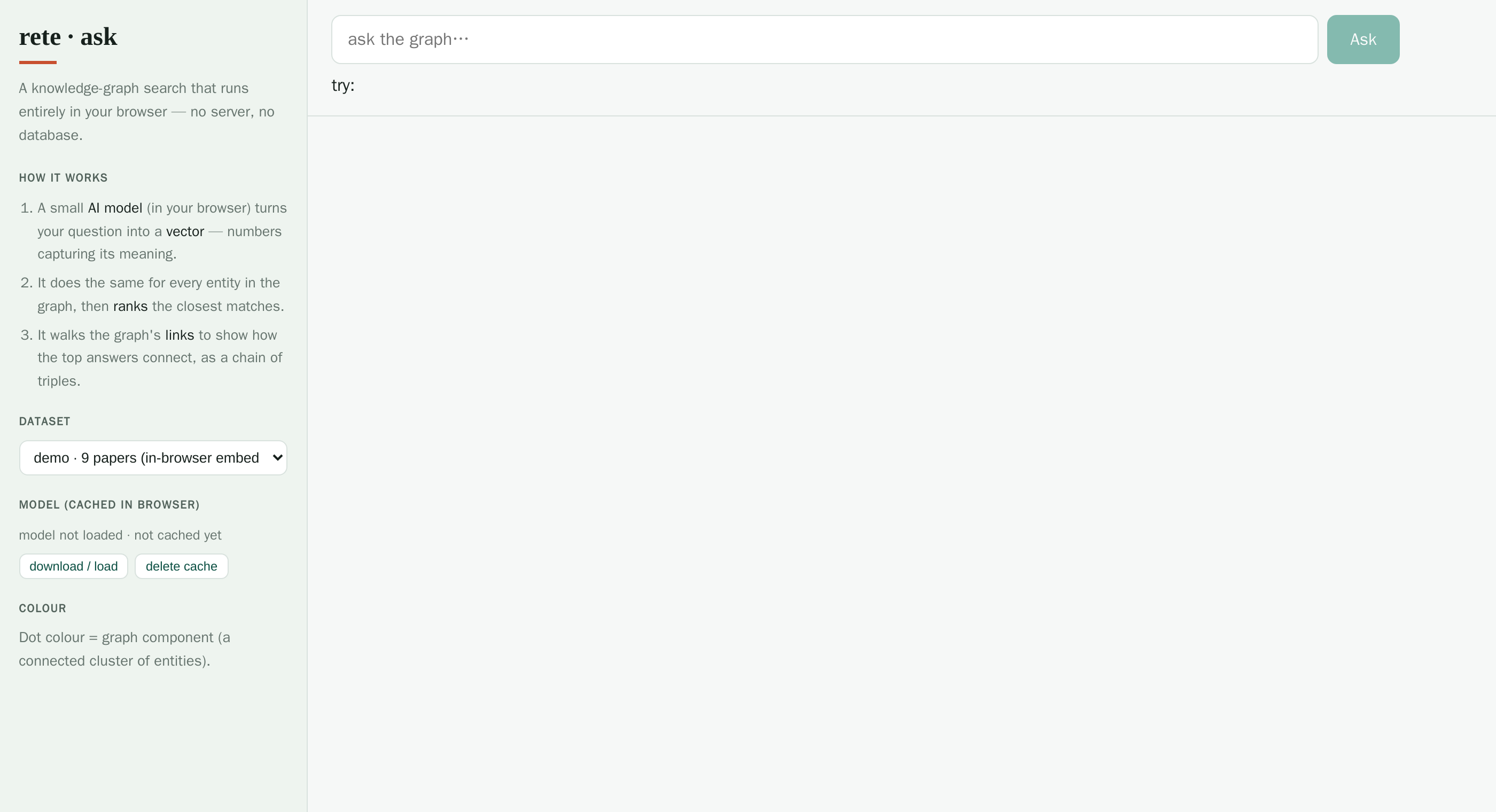
▸ Launch "ask the graph" — a knowledge-graph search that runs entirely in your browser: no server, no database, no API key. You type a question in plain language; it finds the most relevant entities in the graph and shows how they connect.
It's the "simple file, remote; logic in the browser" idea taken to its conclusion — the embedding model and the graph both live client-side, and the ranking is plain cosine similarity over vectors computed on the fly.
How it works
- A small AI model, in your browser, turns your question into a vector. The page loads a multilingual sentence-embedding model with transformers.js (WebGPU when available, falling back to WASM) and caches it locally, so the second visit is instant. The model never leaves your machine.
- It embeds every entity in the graph and ranks the closest matches by cosine similarity to the question vector — a tiny in-browser vector search, no vector database.
- It walks the graph's links to show how the top answers connect, as a chain of triples and an ego-network sketch — so an answer is a path through the graph, not just a list.
The graph is a remote .rete (or an in-browser embed for the bundled demo); the
entity vectors travel alongside it as a small sidecar. The page fetches only what
it needs and does the rest locally.
Datasets
The selector offers a bundled demo (a handful of papers embedded in the page), and remote Wikidata slices (100 MB / 1 GB) served over HTTP range from the project's storage. Pick one, let the model warm up once, and ask away.
The same idea has since graduated into the playground: its Semantic search tab runs an in-browser RAG over any dataset that ships a precomputed embedding index — see the playground guide.
This page is part of the
graph-map / lance-rag experiments; the model + vector approach
(transformers.js in the browser, vectors as a sidecar to the .rete) is written
up there. For the query engine itself, see SPARQL support and
the WASM & JavaScript API.