Architecture vs Structure — one building, two BIM models
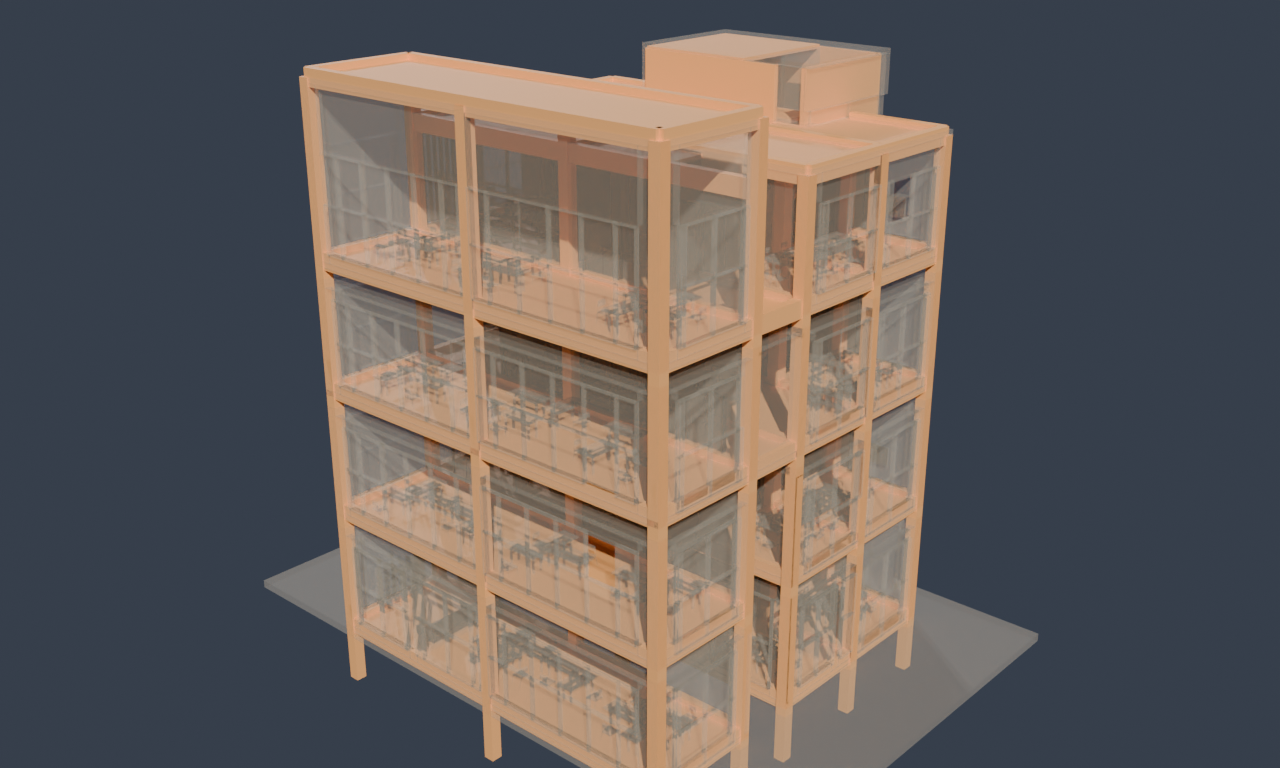
▸ Open the paired 3D viewer → — the same building, modelled twice by one team of the TUM BIM Project course: an architectural model (the envelope — walls, curtain walls, doors, windows, furniture) and a structural model (the load-bearing skeleton — beams, columns, slabs). Toggle between them, or overlay the skeleton inside a translucent envelope. Pick a different project from the selector, download either raw IFC, or run SPARQL over all 224 models — the ⌕ button opens a query panel on the corpus.
The models are Draco-compressed and streamed from the cloud (the three.js community's standard for web-delivered geometry): the architectural GLBs shrink ~6–15× — e.g. 47 MB → 3 MB — so the viewer stays snappy even on a phone.
Why two models
In real BIM practice the architect and the structural engineer each build their own model of the same building, in their own tool, carrying their own subset of the components. The GNI BIM Project course reproduces that: seven of nine teams delivered a paired architectural + structural IFC of one building. This viewer puts that pair side by side. In the Both overlay the structural frame sits inside a translucent architectural envelope — you can see exactly how the beams, columns and slabs carry the walls and floors above them.
The contrast is stark and typical: Project 0's architectural model has 2,132 elements (walls, curtain walls, furnishing, openings) against the structural model's 149 (beams, columns, slabs) — the envelope is ~14× denser than the skeleton. Across all seven pairs the architectural models average ~5,600 elements, the structural ones ~415.
The whole corpus, queryable
This one pair is a window onto a much larger dataset. The full GNI BIM corpus — 224 anonymized IFC models from TUM's Georg Nemetschek Institute — is a queryable rete graph: each model with its discipline, IFC schema, and a per-class element tally. Ask how 208 students modelled the same building (element counts range from 130 to 5,689), compare architecture vs structure across every project, or rank the 42 IFC element classes across the corpus. It is the wide companion to the single, deep FZK-Haus building.
Models: TUM GNI BIM Dataset (Wang, Fuchs, Wu, Esser, Wrabel & Borrmann), CC BY 4.0. Viewer and graph by rete.