WASM & JavaScript API
crates/rete-wasm compiles the same engine (dictionary, permutation indexes,
SPARQL, zstd decode) to WebAssembly, so a web page queries a .rete file
client-side with no server. web/index.html is a working serverless explorer.
Build
docker compose build wasm
docker compose run --rm wasm
This runs scripts/build_wasm.sh: it builds web/pkg, web/pkg-nomodules, and
web/pkg-nomodules-async from one checkout, regenerates the playground, and
writes wasm-build.json with the source revision, pinned tool
versions, sizes, and SHA-256 digests. The gitignored embedded .rete datasets
listed in scripts/build_playground.py must already be staged under web/.
When the checkout is a Windows Git worktree mounted into Linux, pass the
revision because the worktree's host .git indirection is not visible:
docker compose run --rm -e RETE_SOURCE_REVISION=$(git rev-parse HEAD) wasm
The image carries Binaryen v108 for the Asyncify transform. That version
corrupts modern wasm-bindgen extern-reference tables, so regular web and
no-modules builds deliberately use wasm-pack --no-opt; Rust's release
profile still optimizes them. The Asyncify build disables reference types
before its explicit, pinned Binaryen transform.
zstd's C encoder isn't used on wasm; decoding uses the pure-Rust ruzstd, so the
browser reads compressed files fine. rete-wasm depends on rete-core with
--no-default-features.
Stable JS API
The 1.0 stable surface is Graph, RemoteGraph, build, query,
query_sparql, header_ranges, summary_overview, and the validation and
reasoning functions documented below. reach_parallel and the threads
feature are experimental; the Asyncify artifact is an alternative transport,
not a different graph/query API.
Functions take file bytes as Uint8Array and return JSON strings. Every
Rete-owned JSON object envelope includes "schemaVersion": 1; compatibility
functions that return a bare array (graph_names, query_triples,
query_sparql, searches, communities, and reachability) remain arrays.
Binding failures throw JavaScript Error objects rather than strings.
| Function | Returns |
|---|---|
info(bytes) | { schemaVersion, quads, terms, pyramidLevels, namedGraphs } |
graph_names(bytes) | array of named-graph IRIs |
query_triples(bytes, s?, p?, o?) | [[s,p,o], …] (omit a position for a wildcard) |
why_triples(bytes, s?, p?, o?) | { pattern, resultCount, results:[{ terms, ids, provenance }] } for triple-pattern provenance |
query_sparql(bytes, query) | SELECT-only compatibility wrapper; array of solution objects { var: value, ... } |
prefix_search(bytes, prefix, limit) | label-prefix autocomplete from the label index: [{ label, subject }] (no literal scan) |
text_search(bytes, words, prefix, limit) | full-text (--text-index) word/AND search: [{ subject }]; words is a JSON array string, prefix an optional token-prefix |
schema(bytes) | { classes: [["<iri>",count]], relations: [["s","p","o",count]] } |
shacl(bytes, shapes, graph?, format?) | SHACL Core validation against Turtle shapes; report as text/json/ttl per format |
file_layout(bytes) | the physical section map (offsets/lengths of header, dictionary, index, pyramid, …) behind the playground's layout view |
header_ranges(headerBytes) | { schemaVersion, dictOffset, dictLen, pyramidOffset, pyramidLen, indexOffset, indexLen } |
summary_overview(bytes) | { schemaVersion, round, communities, predicateTotals: [["<iri>",count]] } |
progressive_query(bytes, query) | SELECT/ASK envelope for summary-safe COUNT/ASK shapes, plus progressive metadata |
query(bytes, query, format) | any SPARQL form, tagged by kind (see below) |
communities(bytes, round?) | [{ community, size, triples }, …] (Louvain decomposition) |
query_communities(bytes, query, round?) | a SELECT evaluated with the community-split strategy (stars per community, global joins — exact rows), plus communities: [{ community, subjects, rows }] |
pyramid_tree(bytes) | the full community pyramid: per dendrogram round, every community's node/triple counts and its parent at the next-coarser round |
reach(bytes, predicate, seeds, reverse) | [{ seed, count, reached:["<iri>",…] }, …] (serial transitive reach) |
build(text, format) | a complete .rete file image (Uint8Array) built from RDF text |
sparql_url(url, query, format) | worker-only: the query envelope evaluated against a remote URL via lazy HTTP range reads, plus remote: { fileLength, bytes, requests } |
why_url(url, s?, p?, o?) | worker-only: triple-pattern provenance over a remote URL (why_triples lazily), plus remote:{…} |
reach_url(url, predicate, seeds, reverse) | worker-only: transitive reachability over a remote URL, faulting only the traversed tiles, plus remote:{…} |
schema_url(url) | worker-only: the Schema view (classes/relations) from a remote file's schema pyramid, plus remote:{…} |
shacl_url(url, shapes, format?) | worker-only: lazy SHACL — validates the remote default graph, range-reading only each shape's targets, plus remote:{…} |
shacl_construct_url(url, shapes, construct) | worker-only: SHACL over just the subgraph a CONSTRUCT selects (only its tiles fetched), plus remote:{…} |
new Graph(bytes) → .query, .query_reasoned, .query_opts, .query_triples, .prefix_search, .text_search, .why_triples, .schema, .reach, .shacl, .reason, .query_communities, .pyramid_tree, .file_layout, .info, .graph_names | a file opened once and kept resident in memory, so repeated calls reuse the decoded dictionary/index — the stateful local mirror of the free functions |
new RemoteGraph(url) → .query(query, format), .query_reasoned, .query_opts, .prefix_search, .text_search, .stats(), .content_hash() | worker-only: a remote URL opened once and kept resident, so repeated queries reuse the block cache + faulted tiles + decoded dictionary (see Caching remote reads) |
reason(bytes, graph?) | OWL RL / RDFS coherence over an in-memory graph: { kind:"reasoning", coherent, inferredCount, inconsistencies:[{kind,detail}] } |
check_schema(bytes) | index-free Tier-0 schema coherence: { kind:"schemaCoherence", coherent, schemaPoints:[{kind,detail}], readsIndex:false } |
check_schema_url(url) | worker-only: Tier-0 schema coherence over a remote URL from ~2–3 ranges (header + dictionary + pyramid-meta, never the triple index), plus remote:{…} |
reason_construct_url(url, construct) | worker-only: Tier-1 selective coherence — reason over just the subgraph a CONSTRUCT selects (only its tiles are fetched), plus remote:{…} |
reason_url(url, graph?) | worker-only: Tier-2 full coherence over a remote URL (materializes the whole graph), plus remote:{…} |
register_local_file(url, blob) / forget_local_file(url) | worker-only: map a rete-local:… address onto a File/Blob, so every *_url entry point above reads it lazily — see Local files, read lazily |
Local files, read lazily
A File the user picked can be range-read exactly like a URL. Register the blob
under an address whose scheme is rete-local:, then pass that address to any
*_url function or to new RemoteGraph(…):
// inside a Web Worker (register_local_file's reads use FileReaderSync)
wasm_bindgen.register_local_file("rete-local:1/graph.rete", file);
const g = new wasm_bindgen.RemoteGraph("rete-local:1/graph.rete");
JSON.parse(g.query("SELECT ?p ?o WHERE { <…/s42> ?p ?o }", "table"));
g.stats();   // {fileLength, bytes, requests} — how little was actually read
It is the same reader as the HTTP one with a different bottom transport:
Blob.slice() + a synchronous FileReaderSync instead of a ranged GET. The
header-window cache, range batching, block cache and polyglot detection all
apply unchanged, and stats() counts blob reads the way it counts requests.
Three things follow from that, and all three matter:
- Worker-only, like every other lazy read here —
FileReaderSyncdoes not exist on the main thread. - Both engine builds work. A local read never suspends, so the asyncify
variant never routes it through
env.rete_fetch_ranges. - A registration belongs to one wasm instance. Rebuild the worker (an engine switch, a trap, a memory reclaim) and the map starts empty — re-register the same address before opening again.
register_local_file rejects an address that does not begin with rete-local:,
so an ordinary URL can never be silently answered from a blob.
Below ~128 MB the playground still reads a local file whole: that path is faster
when the query touches everything, and the tabs needing a resident graph
(Explore, Map, Build) depend on it. Above it, the whole-file read is what kills
the tab, so lazy is the default. Override with
localStorage.localLazyAboveMB (0 forces lazy for every local file) — the
browser's counterpart to the CLI's RETE_LOCAL_LAZY_ABOVE_MB.
query runs SELECT / ASK / CONSTRUCT / DESCRIBE via eval_query and returns a
single JSON envelope with a kind field:
- SELECT →
{ "schemaVersion":1, "kind":"select", "vars":[…], "rows":[ {var:value,…} ] } - ASK →
{ "schemaVersion":1, "kind":"ask", "boolean": true|false } - CONSTRUCT/DESCRIBE →
{ "schemaVersion":1, "kind":"construct", "format":"ttl"|"jsonld", "text":"…" }whenformatis"ttl"/"jsonld", else{ "schemaVersion":1, "kind":"construct", "triples":[[s,p,o],…] }.
Graph.query_reasoned(query, format) is query with OWL 2 QL entailment on
(see Reasoning); Graph.query_opts(query, format, reason, union) — and the same two methods on RemoteGraph — makes both opt-in
evaluation toggles explicit: reason is the entailment switch, union the
non-standard union default graph mode, where
a pattern outside GRAPH matches the merge of the default graph and every
named graph. Both default to off, and plain query never applies either. One
cost to know: on a RemoteGraph, a union query over a many-graph file may
fault the index tiles of every named graph the merge touches (the
empty-default + single-named-graph shape stays a zero-copy borrow), so the
merge is strictly per-query opt-in.
communities recomputes the Louvain community decomposition (optionally at a
given dendrogram round) and returns per-community member and triple counts —
the data behind the playground's "split by community" view.
reach computes multi-source transitive reachability over one predicate.
seeds is a JSON array string of seed IRI tokens (e.g. '["<http://ex/app>"]');
a single bare IRI is also accepted. With reverse=true it traverses edges
backward ("who reaches the seed?" — impact analysis). It returns one entry per
seed in input order: { seed, count, reached }, or { seed, error } for a seed
not in the graph (so one unknown seed never fails the whole call). It runs
serially — the browser engine is single-threaded; the native CLI's
rete reach --parallel fans one task per seed for a real speedup.
build is the ingest path in reverse direction from everything above: it takes
RDF text (format: "nt" N-Triples, "nq" N-Quads — named graphs become a
dataset — or "ttl" Turtle) and assembles a complete .rete file image in the
browser: dictionary, permutation indexes, and the community pyramid. The bytes
it returns are immediately queryable by every other function, and downloadable
as a file. One caveat: the wasm engine ships only the pure-Rust zstd decoder,
so in-browser builds write uncompressed sections (codec NONE) — every reader
accepts them, but rete build produces a smaller file from the same input.
This powers the playground's Build tab.
build also takes "trig". Turtle and TriG read << s p o >> as an
RDF-star quoted triple. For RDF 1.2 input (<<( s p o )>> triple terms,
<< s p o >> reifiers, {| … |} annotations, "…"@lang--dir literals) call
build_with_card_syntax(text, format, cardJson, "rdf12"), the browser half of
rete build --quoted-triple-syntax. The same Turtle file is a different graph
under each surface, and nothing in the bytes says which was meant, so the
caller chooses; under "rdf-star" the function is byte-identical to
build_with_card. N-Triples and N-Quads read both spellings either way.
sparql_url runs full SPARQL against a remote .rete URL without
downloading it: it reads the header, the dictionary chunk directories and
index tile directories, then faults in only the dictionary chunks and index
tiles the query touches — and full scans coalesce adjacent tiles into batched
range reads, so even ?s ?p ?o costs a handful of requests, not one per
tile. The result envelope is the same as query, plus a remote object
reporting exactly how little of the file was fetched.
The design constraint, honestly: the engine is synchronous, and wasm cannot
block on fetch. Instead of an async engine refactor, the byte-range reads
use synchronous XHR — which browsers permit only inside Web Workers. So
call sparql_url from a worker (see web/sparql-url-worker.js and the
"Remote SPARQL" section of the demo page); on the main thread the browser
throws. The host must answer Range requests with 206 Partial Content
(a host that ignores Range is rejected loudly, never silently mis-read)
and send CORS headers when cross-origin. A range fetch that fails mid-query
is an error — never a silently incomplete result.
The length probe uses a one-byte ranged GET (reading the total from
Content-Range) rather than HEAD, since some hosts reject HEAD —
notably Hugging Face's signed-redirect storage, which answers 405.
Caching remote reads
Range reads are cached, so re-running or refining a query on a remote dataset re-fetches almost nothing. Two layers:
- Within a query — a block cache. The lazy reader wraps the raw HTTP-range
backend in a
BlockCacheReader: every read is served from a 64 KiB aligned block, fetched once and kept. A query's scattered tile reads that fall in the same block cost a single fetch (and a multi-range host coalesces the block fetches further). This works over any single-range backend — S3, a CDN — not just a multi-range gateway. - Across queries — a resident session.
RemoteGraphopens a URL once and keeps theReteresident, so the block cache and the faulted index tiles and the decoded dictionary chunks all survive between queries. The playground's worker holds oneRemoteGraphper URL, so exploring a remote dataset — refining a filter, paging entity tables, re-running — reuses everything already fetched: a fully cached re-run fetches 0 bytes, and the result line shows "0 new bytes, all served from this session's cache" with the cache's size. (The freesparql_urlopens a fresh file each call, so it gets only the within-query block cache — useRemoteGraphfor cross-query reuse.)
RemoteGraph.stats() returns the session's cumulative { schemaVersion, fileLength, bytes, requests }; the worker diffs successive calls to report one
query's physical traffic versus the running session total.
- Across reloads and sessions — an opt-in persistent range cache. The
playground's Settings → Persist fetched ranges across reloads toggle installs
a tiny
XMLHttpRequestshim in each engine worker that mirrors fetched bytes into IndexedDB in 1 MiB blocks (keyed by the file's origin + path) and warms them back on the next load — so a reload re-fetches nothing already held, and the cache survives browser sessions until cleared. Settings shows a per-file breakdown — each cached.retewith how much of it is held (e.g. 16 MB / 1.04 GB · 1.6%) and a fill bar — plus per-file and global Clear. It is off by default, so the default read path is byte-identical with the shim absent. - Whole-file cache mode — one download, then local. Choosing Cache for a
catalog dataset downloads that complete
.reteonce and stores it in the playground's IndexedDB whole-file store. Queries open those bytes in memory; reloads and later browser sessions reuse the stored file with zero network reads. The entry appears under Settings → Whole-file caches, where it can be removed. If IndexedDB is unavailable or quota is exhausted, the current page still uses its in-memory copy, but a later reload must download it again.
Host CORS, in practice. Range-querying from the browser needs a host that
serves the bytes directly to a cross-origin browser request. A plain static
server with CORS works; an S3/R2/GCS bucket with CORS works; same-origin always
works. What does not work is Hugging Face's buckets/.../resolve endpoint:
it returns 405 to a cross-origin browser GET even though it serves the
rete CLI fine (the CLI sends no Origin). The bytes themselves are reachable
— the resolved signed CDN URL answers 206 to the browser — but the resolve
hop refuses browser requests, so the lazy backends can't follow it. A client
should probe its data URL on load and surface a clear banner when the
host isn't browser-reachable; point at a CORS-enabled direct host to light up
the remote backends.
Production catalog contract. Playground datasets are served directly from
https://data.graphplaza.com (Cloudflare R2), one folder per dataset, without a
redirect or token. Every published .rete must use stable format generation 1
(header byte 0x05) and expose Content-Range, Content-Length,
Accept-Ranges, and ETag to CORS callers. web/datasets.lock.json pins each
catalog object's size, content hash, and format byte. Run
uv run python scripts/check_dataset_catalog.py --all before a release to probe
all URLs with a browser-style Range request and verify the lock.
Parallel range reads (opt-in). Sequential synchronous XHR serialises a
query's round trips. With cross-origin isolation the explorer can read the
faulted ranges in parallel: a pool of fetch workers pulls them (each a
synchronous XHR, parallel across the pool) into a SharedArrayBuffer,
Atomics-coordinated, and the engine blocks until they land — read_at falls
back to sequential when isolation is unavailable, so there is never a
regression. Static hosts don't send COOP/COEP, so it is opt-in via
?parallel=1 (a bundled coi-serviceworker.js injects the headers and the
page reloads once); the default page stays un-isolated so the cross-origin
DuckDB-WASM / SQLite backends keep working.
why_triples exposes the same result-provenance path as rete why. It resolves
the optional triple pattern through Rete::query_with_provenance and returns
browser-style camelCase fields: resultCount, matchedPattern,
indexPermutation, indexSection, dictionaryRange, indexRange,
indexSectionRange, and pyramidRange. indexRange is the full permutation
container; indexSectionRange is the selected permutation payload inside it.
Tile provenance reports the physical tile holding each match —
{ "available": true, "id": "SPO/3", "range": { … } }.
Minimal example
import init, { info, query_sparql } from "./pkg/rete_wasm.js";
await init();
const bytes = new Uint8Array(await (await fetch("/data.rete")).arrayBuffer());
console.log(JSON.parse(info(bytes)));
const rows = JSON.parse(query_sparql(bytes,
  `PREFIX e: <http://ex/> SELECT ?y WHERE { e:Alice e:knows ?y }`));
Progressive loading (overview without the index)
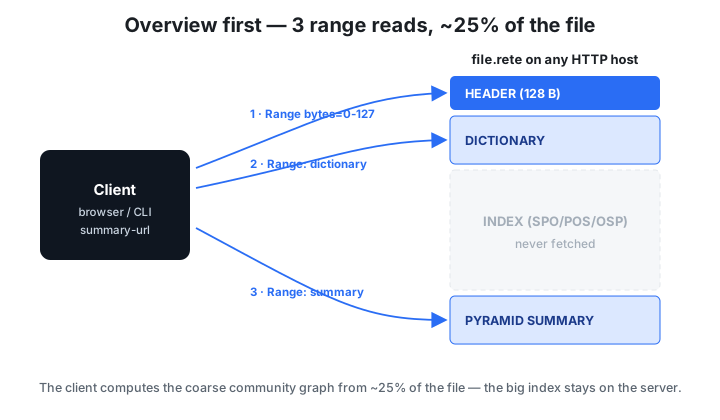
Three small range requests — header + dictionary + summary — build the coarse graph. On the published davidrumsey.rete that is 17.4 MB of 74.8 MB (23.3%); the 42.6 MB of permutation indexes are never downloaded.
header_ranges + summary_overview implement the "overview first" path in the
browser: read the 1 KB header (bytes 0..1024), learn where the dictionary and
pyramid summary live, range-fetch only those, and compute the coarse graph —
the large triple index is never downloaded.
import init, { header_ranges, summary_overview } from "./pkg/rete_wasm.js";
await init();

const range = async (off, len) => new Uint8Array(await (await fetch(url, {
  headers: { Range: `bytes=${off}-${off + len - 1}` }
})).arrayBuffer());

const total  = +(await fetch(url, { method: "HEAD" })).headers.get("content-length");
const header = await range(0, 1024);
const r      = JSON.parse(header_ranges(header));

const buf = new Uint8Array(total);                 // index region left zero
buf.set(header, 0);
buf.set(await range(r.dictOffset, r.dictLen), r.dictOffset);
buf.set(await range(r.pyramidOffset, r.pyramidLen), r.pyramidOffset);

const overview = JSON.parse(summary_overview(buf)); // index never fetched
This is the same path as rete summary-url natively. It's verified end-to-end in
rete-wasm's Node test: with the index region zero-filled, the overview still
computes — 3 ranges, and 23.3 % of the file on davidrumsey.rete.
progressive_query uses the same summary-only path for query answering. It is
intentionally conservative and returns an error unless the query is exactly one
of these shapes:
SELECT (COUNT(*) AS ?n) WHERE { ?s <predicate> ?o }SELECT (COUNT(*) AS ?n) WHERE { ?s ?p ?o }SELECT ?p (COUNT(*) AS ?n) WHERE { ?s ?p ?o } GROUP BY ?pSELECT DISTINCT ?p WHERE { ?s ?p ?o }SELECT (COUNT(DISTINCT ?p) AS ?n) WHERE { ?s ?p ?o }ASK { ?s ?p ?o }ASK { ?s <predicate> ?o }
Successful responses reuse the normal query envelopes and add
progressive, for example:
{
  "schemaVersion": 1,
  "kind": "select",
  "vars": ["n"],
  "rows": [{ "n": "\"42\"^^<http://www.w3.org/2001/XMLSchema#integer>" }],
  "progressive": {
    "stage": "summary",
    "exact": true,
    "readsIndex": false,
    "queryShape": "predicate_count",
    "bytes": 9182,
    "requests": 3,
    "fileBytes": 37210
  }
}
The demo page / playground
docs/playground.html is the static console build. It is generated from
web/playground.template.html plus the source fragments in
web/playground-src/, then inlines the no-modules WASM glue, WASM bytes, and
bundled .rete datasets. It opens directly from file://, defaults to SPARQL,
and keeps SHACL, reachability, schema, and provenance modes available without a
runtime server or bundler. The WASM initializer receives embedded bytes; the
generator removes wasm-bindgen's URL/fetch fallback so app boot cannot silently
go to the network.
Beyond the bundled datasets it also opens remote .rete files lazily over
HTTP range (a 120 MB / 1 GB graph stays interactive because only the touched
tiles cross the wire), caches those reads across queries (above), and federates a
query across several sources via the SPARQL console's + Add source button
— see Federated queries.
Rich result cells and focused cards
Every Table column and Card field has the same explicit render-type menu. In addition to Auto, Text, Link, Button, Image, IIIF, PDF viewer, Map, 3D, Audio, Video, Spin, and Number, two opt-in types handle values that Auto deliberately does not guess:
- Page preview lazily embeds a desktop-shaped thumbnail as the cell nears
the viewport. The iframe uses
sandbox="allow-scripts"andreferrerpolicy="no-referrer"; it cannot gain same-origin access or navigate the parent. A site'sX-Frame-Optionsor CSPframe-ancestorspolicy can still block it, so the cell always retains an Open page ↗ link. - Markdown renders an RDF literal as headings, paragraphs, lists,
blockquotes, emphasis, links, and inline/fenced code. Raw HTML remains escaped,
and only
http:,https:, andmailto:links become anchors. The RDF language badge is preserved.
Every media cell keeps a contextual source link below the preview—Open image, PDF, audio, video, 3D, viewer, manifest, or page—even when its inline preview fails. Clicking an inline PDF page opens a larger paged modal without opening the document a second time; the modal reuses the same PDF.js document and current page. A linearized (Fast Web View) PDF on a server with byte-range support gives the quickest first page. Ordinary PDFs remain compatible: PDF.js may first fetch the file tail or fall back to downloading the complete file. Cross-origin range streaming also requires suitable CORS response headers.
On a fine-pointer desktop, image hover previews grow up to the available viewport but are disabled inside the focused-card dialog. The focused Card view is wider and leaves neighboring cards visible. Navigate it with Prev/Next, Left/Right, native horizontal trackpad scrolling, Shift+wheel, dragging a non-interactive card area, or the visible horizontal scrollbar. Touch devices retain native swipe and vertical scrolling inside long cards.
Find a term
The console's 🔎 Find a term button opens a picker so you don't have to know
a graph's IRIs by heart. It opens on the schema card's classes and predicates
(instant, from the resident card) and, as you type, also searches entities by
label — synchronously for an embedded graph, and over HTTP-range reads (with a
spinner) for a remote-lazy one, using the bounded label index. Click any result
to drop its <IRI> at the cursor.
Each predicate row also carries a values › drill: click it for a faceted
browse of the distinct objects that predicate takes — IRIs resolved to their
human labels, literals shown verbatim — then click one to insert it into the
query. The values for a predicate are read once and cached, so re-opening is
instant; on a remote graph the read is a single bounded range query. The Label
selector at the top chooses which predicate is read as the human label
(rdfs:label, skos:prefLabel, schema:name, … or auto), and the same choice
drives the editor's inline Labels decode chips.
Media & companions
Inline rendering of images / IIIF / 3D / audio / geo cells in playground results — and the asset-preparation pipelines behind them — moved to their own page: Media & SQL companions.