Semantic zoom — the schema pyramid
The one-paragraph pitch. Open any
.reteand ask "what kinds of things are in here?" — and get an answer that zooms. At a glance you see the broad strokes (Agent: 4k, Place: 8k); zoom one step andAgentresolves intoPersonandOrganisation; zoom again andPersonresolves intoScientist,Artist, … down to the leaf classes. It's a map legend with a zoom control, shipped inside the file, and a remote client reads the whole leveled legend in two or three small HTTP range requests — without ever touching the triple index. This is rete's "PMTiles for graphs," applied to types.
The schema pyramid is built automatically whenever your data carries an rdf:type
hierarchy. There is no flag to remember and nothing extra to host — it travels in
the file's pyramid section and is served over the same range-request transport as
everything else.
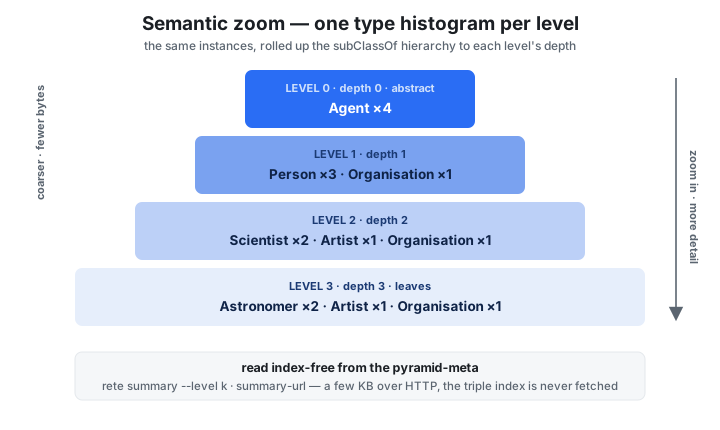
Each level is one type histogram. Read top to bottom and the same instances resolve from abstract classes into leaves — and the whole stack is fetched index-free, in a few kilobytes, over HTTP.
Why it exists
A knowledge graph you've never seen is opaque: you don't know which classes exist, how they relate, or where to start. The flat answer — "here are 200 classes, alphabetical" — is noise. What you actually want is to start coarse and drill down only where it's interesting. That's exactly what a web map gives you for geography; the schema pyramid gives it for ontology.
Three things make this work, and they're really one idea:
- The data's
rdfs:subClassOfaxioms define an abstraction hierarchy (Astronomer ⊑ Scientist ⊑ Person ⊑ Agent). - rete rolls every instance's type up that hierarchy to a chosen depth, once, at build time, and stores one type histogram per level.
- The whole thing lives in the pyramid-meta section, which range-reading clients fetch without the triple index — so it is index-free and instant, the cheapest tier of the three-tier exploration model.
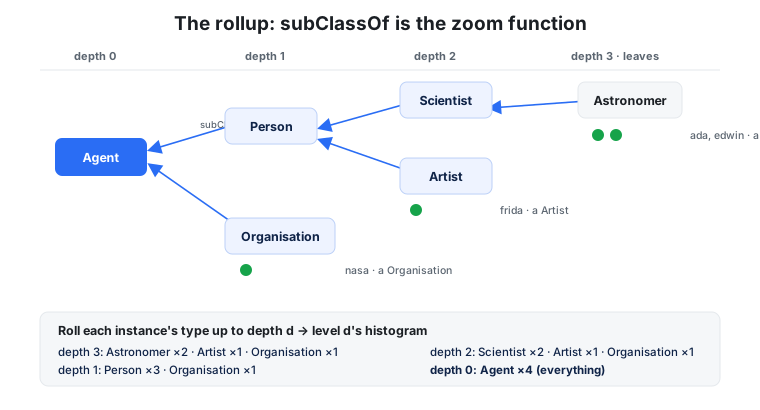
The subClassOf chain is the zoom function: instances live at the leaves, and
rolling their types up to depth d produces level d's histogram — Astronomer
becomes Scientist becomes Person becomes Agent. Nothing is invented; the
ontology in the data does the work.
What you need in the data
| Ingredient | Predicate | Required? |
|---|---|---|
| Typed instances | rdf:type (a) | Yes — no types, no schema pyramid. |
| A class hierarchy | rdfs:subClassOf | Optional — without it the pyramid is a single flat level (= the Dataset Card's class list). |
The subClassOf axioms can come straight from your data, from an ontology file you
merge in at build time, or be inferred with rete build --materialize (the
RDFS/OWL-RL reasoner — see Reasoning). Multiple inheritance is
handled by picking a canonical (lexicographically smallest) parent so the rollup is
a deterministic tree.
Build it
Nothing special: it's part of the normal pyramid, so a plain rete build produces
it. Take this little graph — five classes in a subClassOf tree plus four typed
people/orgs:
# people.nt  (N-Triples; prefixes shown for readability)
ex:Scientist     rdfs:subClassOf ex:Person .
ex:Artist        rdfs:subClassOf ex:Person .
ex:Astronomer    rdfs:subClassOf ex:Scientist .
ex:Person        rdfs:subClassOf ex:Agent .
ex:Organisation  rdfs:subClassOf ex:Agent .

ex:ada    a ex:Astronomer .
ex:edwin  a ex:Astronomer .
ex:frida  a ex:Artist .
ex:nasa   a ex:Organisation .
ex:ada    ex:memberOf ex:nasa .
ex:ada    ex:knows    ex:edwin .
ex:frida  ex:knows    ex:ada .
rete build people.nt -o people.rete
That's it — people.rete now carries the schema pyramid. (If your subClassOf
axioms live in a separate ontology, merge them in the same build:
rete build people.nt ontology.ttl -o people.rete. If they're only implied,
rete build people.nt --materialize -o people.rete infers them first.)
Use it
Browse every level at once
rete summary prints the community super-edge graph and then the schema pyramid —
one line per semantic level, coarse (abstract) at the top:
$ rete summary people.rete
…
schema pyramid — 4 level(s), 6 class(es) in the subClassOf hierarchy:
  level 0 (depth 0, round 1): <http://ex/Agent>×4
  level 1 (depth 1, round 0): <http://ex/Person>×3, <http://ex/Organisation>×1
  level 2 (depth 2, round 0): <http://ex/Scientist>×2, <http://ex/Artist>×1, <http://ex/Organisation>×1
  level 3 (depth 3, round 0): <http://ex/Astronomer>×2, <http://ex/Artist>×1, <http://ex/Organisation>×1
  + 3 per-community descriptor(s) for progressive zoom
Read it top to bottom and the zoom is visible: everything is an Agent (×4);
that Agent is Person ×3 + Organisation ×1; that Person is Scientist ×2 +
Artist ×1; that Scientist is Astronomer ×2. Counts conserve up the
hierarchy — each level re-partitions the same instances at a finer grain.
Zoom to one level
--level k prints just one level's type histogram (0 = coarsest / most abstract):
$ rete summary people.rete --level 0          # the big picture
schema pyramid level 0 — depth 0 (round 1), 1 class(es):
           4  <http://ex/Agent>

$ rete summary people.rete --level 1          # one step in
schema pyramid level 1 — depth 1 (round 0), 2 class(es):
           3  <http://ex/Person>
           1  <http://ex/Organisation>

$ rete summary people.rete --level 3          # the leaves
schema pyramid level 3 — depth 3 (round 0), 3 class(es):
           2  <http://ex/Astronomer>
           1  <http://ex/Artist>
           1  <http://ex/Organisation>
A viewer wires --level k to a zoom slider: render level 0 when zoomed out, fetch
deeper levels as the user drills in.
Over HTTP / S3 — the index-free payoff
This is the selling point. The schema pyramid lives in the pyramid-meta section, so
summary-url fetches it without downloading the file and without touching the
triple index — only the header, dictionary, and pyramid:
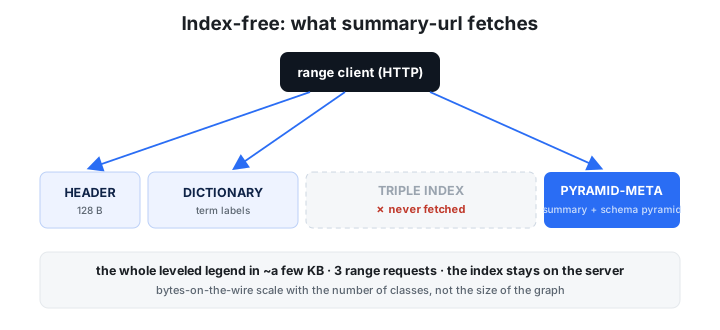
A range client pulls only the header, dictionary and pyramid-meta — three ranges, and never the triple index.
What that costs is set by the dictionary, not by the size of the graph. The
pyramid itself scales with the number of classes and stays small — 1.3 MB on the
published davidrumsey.rete — but resolving those class IRIs back to strings
pulls the dictionary along with it, so the three reads total 17.4 MB of a
74.8 MB file (23.3 %), measured with rete cost. On a small file the same
three reads are tens of kilobytes. Either way the permutation indexes — 56.9 %
of that file, and the majority of every published one — are never requested.
$ rete summary-url https://host/people.rete
…
schema pyramid — 4 level(s), 6 class(es) in the subClassOf hierarchy:
  level 0 (depth 0, round 5): <http://ex/Agent>×2847, <http://ex/Place>×1153
  …
fetched 27337 of 161420 bytes in 3 range request(s) — index NOT fetched
The bytes-on-the-wire are bounded by the number of classes, not the size of the
graph — the same leveled legend costs roughly the same whether the file is a
megabyte or a gigabyte. Put the .rete on any range-capable host (S3, a CDN,
GitHub Pages) and a browser or CLI gets a zoomable type map for the cost of a few
kilobytes. See Dataset Cards → the three-tier model
for how this tier sits alongside the index-free card-url and the lazy
sparql-url tiers.
Read it programmatically
The Rust API exposes the pyramid index-free through SummaryView
(rete-core), which reads only the header + dictionary + pyramid ranges:
use rete_core::{SummaryView, SliceReader};

let view = SummaryView::open_ranged(&SliceReader::new(&bytes))?.unwrap();
for k in 0..view.level_count() {
    let level = view.level_rollup(k).unwrap();
    println!("level {k} (depth {}):", level.depth);
    for (class, n) in &level.classes {
        println!("  {n:>8}  {class}");
    }
}
// view.class_hierarchy : the subClassOf DAG with per-class depth
// view.descriptors     : per-community descriptors (below)
Any RangeReader works here — back it with an HTTP client and you read the schema
pyramid straight off a URL.
A graph, not a tree — multiple parents and lateral links
A real ontology isn't a strict tree. Two things break the "every class sits in exactly one branch" assumption, and the schema pyramid keeps both:
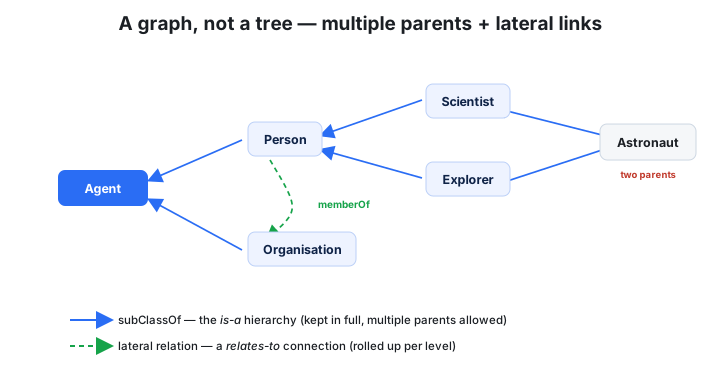
1. Non-exclusive subClassOf (multiple inheritance). A class can be a subclass
of several others — Astronaut ⊑ Scientist and Astronaut ⊑ Explorer. The
shipped hierarchy keeps all parents, so it is a directed acyclic graph, not a
tree. (A single canonical parent — the lexicographically smallest — drives the
deterministic depth/rollup; the rest are preserved as cross-links you can
navigate.) On ClassNode you get parents: Vec<String> and canonical_parent().
2. Lateral connections (the non-is-a relations). Beyond "is-a", classes are
connected — Person memberOf Organisation, Person knows Person. The pyramid
rolls these relations up per level too, so each level is a small graph, not
just a histogram. Zoom out and the relations abstract along with the types:
$ rete summary people.rete --level 1          # concrete
  3  <http://ex/Person>
  1  <http://ex/Organisation>
  relations at this level (2):
       2  <http://ex/Person> --<http://ex/knows>-> <http://ex/Person>
       1  <http://ex/Person> --<http://ex/memberOf>-> <http://ex/Organisation>

$ rete summary people.rete --level 0          # abstracted
  4  <http://ex/Agent>
  relations at this level (2):
       2  <http://ex/Agent> --<http://ex/knows>-> <http://ex/Agent>
       1  <http://ex/Agent> --<http://ex/memberOf>-> <http://ex/Agent>
Person memberOf Organisation becomes Agent memberOf Agent as you zoom out — the
connections are preserved and generalized, never dropped. So the answer to "can
the pyramid be non-exclusive and keep connections?" is yes, by construction:
it's a leveled multigraph over the ontology, not a leveled tree. On the API these
are view.level_links (Vec<LevelLinks>, each a Vec<ClassRelation>).
Per-community descriptors (progressive zoom)
Alongside the global levels, the pyramid ships a descriptor per community: its
dominant class, local type histogram, and — when the data has them — a geographic
bounding box (CRS84 lon/lat) and a temporal range. These let a client refine the
global picture locally — "what's in this region / this cluster?" — again without
fetching any triples. They're available on view.descriptors.
Status. The descriptors describe communities and ship in the index-free pyramid-meta today. The physical per-community triple tiles they're designed to annotate are a separate, in-progress storage step; until those land, a descriptor is a standalone summary of its community.
No hierarchy? It still works
If your data has types but no subClassOf, the pyramid degrades gracefully to
a single flat level — exactly the class histogram you'd get from the Dataset
Card — so rete summary --level 0 always answers. Add a hierarchy (or
--materialize) later and the levels appear automatically on the next build.
How the ontology is embedded in the format
The ontology isn't a sidecar — it is derived once at build time and written into the file's own sections, where range clients read it without the triple index. Three orthogonal structures are embedded, each answering a different question:
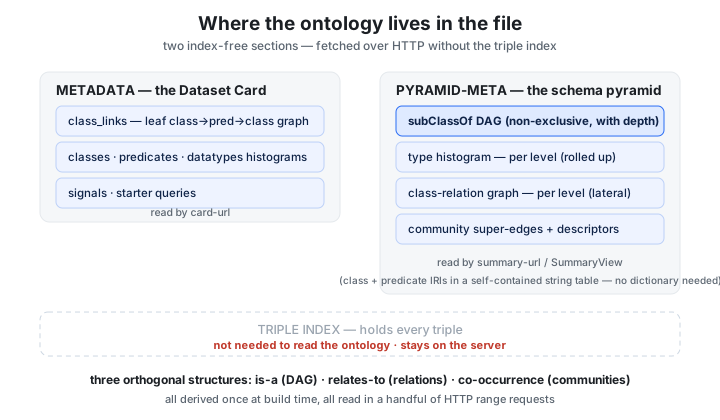
| Structure | Question it answers | Where it lives | Read by |
|---|---|---|---|
subClassOf DAG (non-exclusive, with depth) | is-a — how classes generalize | pyramid-meta (v2) | summary / summary-url |
| Per-level type + relation rollups | what & how, at each zoom | pyramid-meta (v2) | summary --level k |
| Per-community descriptors | what's in this cluster/region | pyramid-meta (v2) | SummaryView.descriptors |
class_links (leaf relation graph) | relates-to — the effective schema | the Dataset Card (metadata) | card / card-url |
| Community super-edges | co-occurrence — topological structure | pyramid-meta (v1) | summary / summary-url |
A few properties that make the embedding work:
- Self-contained. The schema pyramid stores class and predicate IRIs in its own string table, so it can be decoded without the dictionary — the ontology travels as plain text, not dictionary IDs.
- Index-free. Reading any of it never opens the triple index —
rete summary [--level k],summary-url,card-url, andSummaryViewkeep to the header + the small metadata/pyramid ranges. The index stays on the server. - Physically additive (pyramid-meta v2). The schema block is appended after the v1 summary and written only when the graph has types, so a typeless file is byte-identical to a v1 build and an older reader silently ignores the new bytes. See the format spec §7.4 for the exact byte layout.
- Provenance. The
subClassOfaxioms come straight from the data, from a merged ontology file, or fromrete build --materialize(the RDFS/OWL-RL reasoner). The pyramid never invents structure — it embeds the ontology that's already there. - Deterministic & bounded. Same input → byte-identical file (stable content hash, safe to cache). Levels (≤ 6), classes/relations per level, and descriptors are all capped, so the embedded ontology stays small regardless of graph size.
Cost vs benefit — is the pyramid worth it?
Measured honestly (see the benchmark), the two pyramidal structures have very different economics:
- The schema pyramid is bounded — its size and read cost track the ontology (classes/relations), not the graph, so it stays cheap (~tens of KB, ~20 ms read) at any scale. This is the structure that earns its keep for exploration.
- The community super-edge summary scales with the graph and adds build time
(Louvain), and it gives no benefit to node-selective lazy queries. If you only
serve selective SPARQL,
--no-pyramidis smaller and just as fast.
Rule of thumb: keep the pyramid when you want index-free overview/exploration;
drop it (--no-pyramid) when you only serve selective queries at scale.
When to reach for it
- Publishing a dataset people will explore cold — the schema pyramid is the zoomable legend that tells them what to ask.
- A browser/edge client that should show "the shape of the data" before running a single SPARQL query — render level 0 without touching the triple index, drill down on demand.
- Faceted / drill-down UIs — wire the levels to a type facet that starts abstract and refines as the user narrows.
If your data is untyped or has no class hierarchy, the payoff is smaller (a single flat level); everything else here still applies.
See also: Dataset Cards (the self-describing card + starter
queries that ride the same index-free path), Reasoning
(--materialize to infer subClassOf), and the format spec.