Multi-criteria community splitting
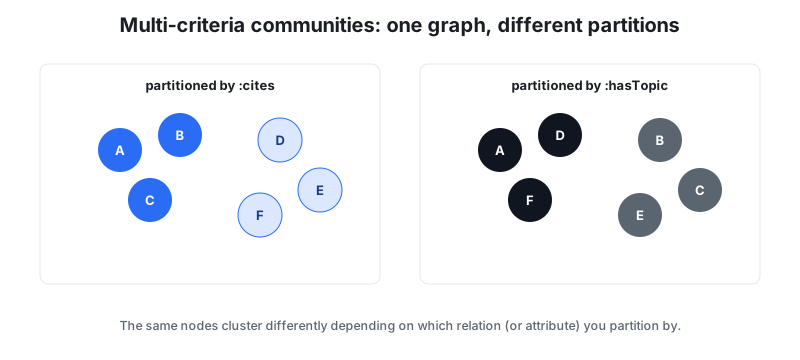
"What community is X in?" has no single answer — it depends on which relation
(or attribute) you group by. rete lets you partition the same graph by
different criteria and compare them. This page is a runnable example.
The data (examples/researchers.nt)
has 8 researchers with three criteria that deliberately disagree:
ex:cites— two dense citation clusters{r1..r4}and{r5..r8}.ex:coauthor— pairs that cross the citation clusters (r1–r5,r2–r6, …).ex:organization— an attribute (OrgX/OrgY).
rete build examples/researchers.nt -o researchers.rete
Criterion 1 & 2 — structural, by a single relation (--predicate)
rete communities --predicate <iri> detects communities using only that
relation's edges, giving a criterion-specific partition:
rete communities researchers.rete --predicate '<http://ex/cites>'
#  community 0: r1, r2, r3 …      (citation cluster A)
#  community 1: r5, r6, r7 …      (citation cluster B)

rete communities researchers.rete --predicate '<http://ex/coauthor>'
#  community 0: r1, r5            (coauthorship crosses the citation clusters)
#  community 1: r2, r6
#  community 2: r3, r7
#  community 3: r4, r8
Same graph, same nodes — different communities depending on the relation.
Citation says "two camps"; coauthorship says "four cross-camp pairs". (With no
--predicate, detection uses all edges and yields a blended partition.)
Criterion 3 — attribute, via SPARQL (free, overlapping-friendly)
Attribute groupings ("everyone at OrgX", "papers tagged biology") need no special
feature — they're a GROUP BY:
rete sparql researchers.rete \
  "PREFIX e: <http://ex/> SELECT ?org (COUNT(?r) AS ?n) WHERE { ?r e:organization ?org } GROUP BY ?org"
#  OrgX 4   ·   OrgY 4
Attribute criteria handle overlap for free (a node can have several tags) and are fully queryable — no partition needed.
Combining criteria
"Find groups coherent in both discipline and organization" is consensus /
multi-view clustering — a downstream analysis, exactly like the
LDA pipeline: rete supplies each criterion's partition
(and per-community profiles), and a
consensus step combines them. Likewise, overlapping community detection (a
node in several communities — link communities, BigCLAM) is its own algorithm,
not Louvain's hard partition; rete would feed it the same way it feeds LDA.
The one design constraint: physical tiling wants a single partition
The pyramid's tiles exist for byte locality / range-fetch, and that benefits from one partition that minimizes edge cut. So the pragmatic split is:
- One structural partition = the physical layout — pick the dominant /
most-queried relation (e.g.
cites); this is what the on-disk pyramid uses. - All other criteria = logical groupings — via
--predicate(recomputed on demand), via SPARQL attributes, or downstream consensus. No physical cost, fully queryable, overlapping-friendly.
So: attribute criteria are already first-class (SPARQL/schema); multiple
structural criteria are a recompute-on-demand --predicate away; and combining
them is a downstream step rete feeds — with only one partition ever driving the
physical layout.