A real-world scenario: a queryable SBOM on a URL
A worked end-to-end example: publish a software dependency graph (an
SBOM-style slice) as a single .rete file, then answer "what is impacted by this
CVE?" — over HTTP, fetching only the bytes the query needs, with no database.
The data (examples/deps.nt) models packages, their kind
(rdf:type Application/Library), dependsOn edges, and a vulnerable package:
<http://ex/app>     dependsOn  <http://ex/web>, <http://ex/auth>
<http://ex/web>     dependsOn  <http://ex/logging>
<http://ex/auth>    dependsOn  <http://ex/logging>, <http://ex/safejson>
<http://ex/logging> dependsOn  <http://ex/log4x>
<http://ex/log4x>   hasVulnerability  <http://ex/CVE-2099-0001>
1. Validate, then build
Check the source is well-formed RDF first, then pack it:
rete validate examples/deps.nt
#  valid: 13 statement(s) — 13 in the default graph, 0 named graph(s)

rete build examples/deps.nt -o deps.rete
#  wrote deps.rete: 13 triples, 12 terms, 2 pyramid level(s), 2035 bytes

rete verify deps.rete        # confirm the content hash
#  OK — content hash matches
2. Publish
It's one immutable file — upload it anywhere that serves HTTP Range requests:
aws s3 cp deps.rete s3://my-bucket/deps.rete          # S3
# or commit it to a repo and use the raw URL, or any CDN / static host.
No server, no endpoint, no index to maintain. The file's blake3 content hash doubles as an ETag-like id, so clients can cache byte ranges forever.
3. Query it from the URL
The headline question: what does the CVE impact?
Everything that (transitively) depends on the vulnerable log4x:
rete sparql-url https://my-bucket.s3.amazonaws.com/deps.rete \
  "PREFIX e: <http://ex/> SELECT ?d WHERE { ?d e:dependsOn+ e:log4x }"
#  4 solution(s)
#  (fetched 2035 bytes in 1 range request(s); file is 2035 bytes)
#  ?d=<http://ex/auth>
#  ?d=<http://ex/logging>
#  ?d=<http://ex/web>
#  ?d=<http://ex/app>
safejson is correctly excluded — it doesn't reach the vulnerable package. At
this toy size the whole file fits in one bounded range request; on a real
graph the same query pulls a handful of small ranges — dictionary chunks and
index tiles — from a file thousands of times larger, never scanning linearly.
Just the affected libraries, with the CVE id
rete sparql-url https://my-bucket.s3.amazonaws.com/deps.rete \
  "PREFIX e: <http://ex/>
   SELECT ?lib ?cve WHERE {
     ?lib e:dependsOn+ ?v . ?v e:hasVulnerability ?cve .
     ?lib a e:Library
   }"
A simple point lookup (triple pattern, no SPARQL)
rete query-url https://my-bucket.s3.amazonaws.com/deps.rete \
  --predicate '<http://ex/hasVulnerability>'
Overview first, without downloading the index
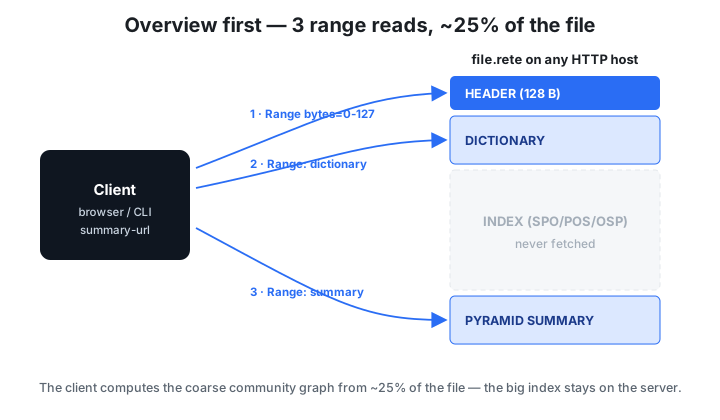
The overview path: header + dictionary + summary in three range reads — 23.3% of davidrumsey.rete; the triple index stays on the server.
rete summary-url https://my-bucket.s3.amazonaws.com/deps.rete   # community quotient graph
rete schema      deps.rete                                       # classes & relations (local)
4. Querying with plain curl
There is no query endpoint — a .rete query is a set of HTTP Range reads
that the rete client (or the WASM engine) performs. You can watch and even
drive those reads with curl.
The whole file is tiny here; fetch it and query locally:
curl -s https://my-bucket.s3.amazonaws.com/deps.rete -o deps.rete
rete sparql deps.rete "PREFIX e: <http://ex/> SELECT ?d WHERE { ?d e:dependsOn+ e:log4x }"
See the range mechanics directly — the first 1024 bytes are the header, and a
Range request returns 206 Partial Content:
# Fetch just the header (bytes 0–1023); confirm the magic and partial response:
curl -s -r 0-1023 https://my-bucket.s3.amazonaws.com/deps.rete | head -c 4 ; echo
#  RETE
curl -sD - -o /dev/null -r 0-1023 https://my-bucket.s3.amazonaws.com/deps.rete | grep -i '206\|content-range'
#  HTTP/2 206
#  content-range: bytes 0-1023/2035
That 206 is the contract: a host that ignores Range and returns 200 is
rejected by the client (it would otherwise read the wrong bytes). For large
files, this is the whole point — a point query pulls a handful of kilobytes from a
multi-megabyte file instead of the entire thing.
5. In the browser
The same file serves a zero-backend web app: the browser engine
range-fetches the overview first, then runs SPARQL client-side. A security
dashboard could load deps.rete straight from S3 and let users explore impact
with no API to build, deploy, or secure.
What just happened: one static file replaced a graph database + query API. The data is plain RDF, the queries are standard SPARQL, and the transport is ordinary HTTP range requests — so it works on infrastructure you already have.