SPARQL support
The engine lives in rete-core::sparql. Queries are parsed with
spargebra and lowered to a small plan
algebra (Bgp/Join/Union/Minus/LeftJoin/Filter/Path/Values/
Graph), evaluated in the unified integer node space and resolved back to terms
only for final bindings.
Run via the CLI (rete sparql <file> "<query>" [--json]) or in the browser
(query in rete-wasm for any query form; query_sparql is the older
SELECT-only wrapper).
Spatial queries over geo:wktLiteral geometry — point-in-polygon, intersection,
distance — are covered by a focused set of GeoSPARQL functions; see
GeoSPARQL (geometry + time).
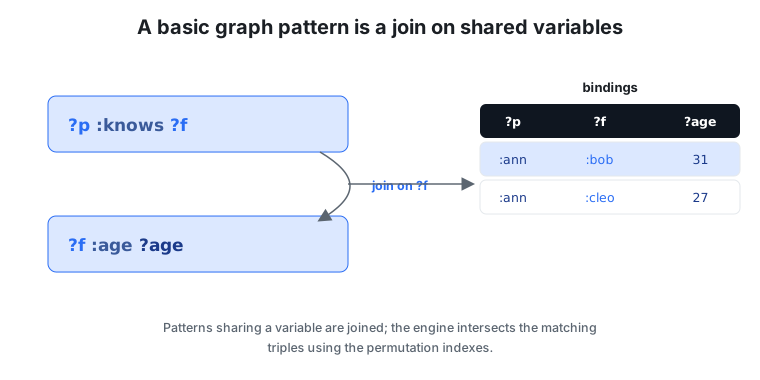
?f are intersected via the permutation indexes.Supported
| Area | Details |
|---|---|
| Query forms | SELECT, ASK, CONSTRUCT, DESCRIBE |
| Patterns | Triple patterns and BGPs evaluated as integer-space hash joins on shared variables; blank nodes as non-distinguished variables |
| Algebra | OPTIONAL (left join), UNION, MINUS, FILTER EXISTS / NOT EXISTS, nested SELECT subqueries (evaluated independently, then joined on shared projected variables) |
| Filters | Comparisons, &&/||/!, arithmetic, BOUND, COALESCE; built-ins incl. CONTAINS, STRLEN, SUBSTR, CONCAT, STR, isIRI/isLiteral/isBlank, DATATYPE, LANG, REGEX |
| Property paths | p+, p*, p? (zero-length included for */?), reverse ^p, sequence a/b, alternative a|b — evaluated goal-directed from a bound endpoint |
| Solution modifiers | DISTINCT, ORDER BY (ASC/DESC), LIMIT, OFFSET, VALUES, BIND |
| Aggregation | GROUP BY, HAVING, COUNT/SUM/AVG/MIN/MAX (incl. COUNT(DISTINCT …)) |
| Datasets | GRAPH <iri> / GRAPH ?g, FROM (RDF-merge default graph), FROM NAMED (scope which graphs GRAPH sees); EXISTS honors the active graph. Plus an opt-in, non-standard union default graph mode for named-graph-heavy files. |
| Output | SPARQL Results JSON (--json), with correct uri/literal/bnode typing, datatype, and xml:lang; literal values are properly unescaped |
| RDF-star | Quoted triples << s p o >> in subject/object position — ingest (N-Triples-star & Turtle-star), storage, and SPARQL-star: quoted-triple patterns (incl. inner variables << ?s :p ?o >>) and the isTRIPLE / TRIPLE / SUBJECT / PREDICATE / OBJECT built-ins. See below. |
| Reasoning (OWL 2 QL) | Opt-in ontology-mediated answering by query rewriting — no materialization: rdfs:subClassOf / subPropertyOf hierarchy + rdfs:domain / range type inference, computed over the raw data. rete sparql … --entail, or the playground 🧠 Reason toggle. See below. |
Property paths
Property paths are evaluated goal-directed from a bound endpoint and support
p+, p*, p?, reverse ^p, sequence a/b, and alternative a|b.
Zero-length semantics
* and ? include the zero-length path (a node reaches itself); + does not.
This holds in every binding direction:
# Alice plus everyone she transitively knows (includes Alice herself):
SELECT ?y WHERE { ex:Alice ex:knows* ?y }
# Everyone who reaches Carol in ≤1 hop (includes Carol):
SELECT ?x WHERE { ?x ex:knows? ex:Carol }
Index-free aggregates
Exact per-predicate totals come straight from the pyramid summary's superedge counts, without reading the triple index:
rete predicates data.rete # CLI
The same per-predicate totals back the playground's index-free aggregate path.
Evaluation model
The algebra evaluates as a lazy pull pipeline over integer slot rows: joins,
MINUS, DISTINCT, filters, and GRAPH stream, so LIMIT and ASK stop the
underlying index scans early, and under a small known demand joins switch to
index-nested-loop probes. Aggregation, ORDER BY (a bounded top-k when LIMIT
is present), and hash-join build sides are the only blocking points — and
blocking is about ordering, not memory: aggregation folds rows through
per-group accumulators, so resident memory is O(groups), not O(rows) — a
bare COUNT(*) is a single counter, and a GROUP BY over the 1.38 billion
rdf:type rows of the 9.83 B-triple DataCite graph completes inside a 4 GiB
container (numbers on the benchmark page). What still
materializes its input: a no-LIMIT ORDER BY, and a multi-graph FROM (a
single FROM <g> borrows that graph's index without copying). Terms are
resolved to strings only at projection. It is still not a cost-based planner —
join order is a selectivity heuristic — and the benchmark page separates
correctness coverage from latency and calls out the shapes where Oxigraph still
wins.
Community-split evaluation
The engine can also evaluate a SELECT with a split-where-sound,
global-where-not strategy that always returns exactly the whole-graph
answer. The one place the pyramid partition genuinely applies is a subject
star — a group of triple patterns sharing one variable subject — because
tiles partition triples by their subject's community, so a star's solutions
partition cleanly by community. Each BGP is decomposed into its stars; each
star is evaluated per community (the community's subjects pushed in as a
VALUES binding, which the engine turns into index probes); and the stars
are recombined with global hash joins, so multi-hop joins work and
solutions that cross communities survive. FILTER / UNION / OPTIONAL /
MINUS recurse through the same machinery; property paths, inline VALUES,
and GRAPH blocks evaluate globally inside the split (exact by definition);
and GROUP BY / ORDER BY / LIMIT / DISTINCT run once on the merged
rows. A query is refused only when nothing in it can split (no BGP with a
variable subject — the strategy would add nothing) or under FROM / FROM NAMED. The playground's "Split by community" strategy uses this; natively
the per-star, per-community partials are the seam for parallel evaluation.
Union default graph (⛁ All graphs)
Standard SPARQL scopes a pattern outside GRAPH to the default graph, and
the engine keeps exactly that — the W3C conformance suite runs on it. But many
datasets keep every statement in named graphs (anything built from N-Quads:
DCAT catalogs, provenance stores), so on such a file
SELECT (COUNT(*) AS ?n) WHERE { ?s ?p ?o } answers 0. That answer is
correct, and nearly every newcomer reads it as breakage — the published Czech
national open-data catalog (2.28 M quads across 31,974 named graphs, default
graph empty) is the case that proved it.
Virtuoso, GraphDB and Jena TDB (tdb:unionDefaultGraph) all offer a
store-level switch for exactly this, and rete offers the same mode, opt-in
per query: with it on, a pattern outside GRAPH matches the RDF merge of
the default graph and every named graph. Because it is not standard SPARQL,
it is off by default and is never applied implicitly — a plain query never
changes meaning.
Semantics, precisely:
- The merge is a set union: a triple present in several graphs matches
once. The file's own default-graph triples are included (unlike a bare
FROM, which replaces the default graph). - A query that brings its own
FROMkeeps itsFROMdataset — the query named its dataset explicitly, and that wins. GRAPH <iri>/GRAPH ?gandFROM NAMEDare completely unaffected: they enumerate and scope the named graphs exactly as before.
Where it exists today:
- The playground — the ⛁ All graphs toggle beside 🧠 Reason. Flipping it is announced, and every result computed under it says so in its meta line, so a non-standard answer is never silently presented as a standard one. See the playground guide.
- The browser engine —
Graph.query_opts(query, format, reason, union)and the same method onRemoteGraph(see WASM & JavaScript API). - Rust —
eval_query_with(&rete, query, QueryOpts { union_default_graph: true, ..QueryOpts::default() })inrete-core::sparql. - Not on the CLI —
rete sparqlhas no union flag — and not inrete serve's endpoint. If you need the union semantics there, write it into the query withGRAPH ?g { … }(andUNIONwith a default-graph branch when both sides hold data), which works everywhere.
Costs and limits worth knowing before flipping it on:
- The common converted-file shape — empty default graph, exactly one named graph — stays a zero-copy borrow of that graph's index: no copying, no extra bytes.
- Any other shape materializes the merged index for the query. On a lazily-opened remote file that can mean faulting the index tiles of every named graph the merge touches — a real cost on a many-graph file, and precisely why the mode is opt-in per query rather than a file-level default.
- The playground's progressive and community-split strategies answer from default-graph structures, so a union run is evaluated on the whole index instead (the result line says so) rather than silently answering with standard semantics.
- Federated multi-source runs and live SPARQL endpoints keep standard semantics — the toggle does not reach them (a live endpoint decides its own dataset).
- Under union,
DESCRIBE's per-resource expansion — the triples returned about each matched resource — still reads the default graph; the union applies to the pattern matching that selects the resources.
Output views & query shapes
The playground renders one result several ways — Table, Graph, Map, Time, TTL/JSON-LD — and each view expects a particular query shape (a geometry column for Map, a year/date column for Time, …). That matrix lives with the rest of the playground documentation: see Playground — output views.
Federation: SERVICE
SPARQL 1.1 federated query is supported: a SERVICE <endpoint> { … } block is
shipped (as written) to the remote SPARQL endpoint at evaluation time and its
solutions join the surrounding pattern on shared variables — so one query can
span a .rete file and a live endpoint (Wikidata, DBpedia, …):
# Local entities enriched with live DBpedia labels, in one query.
SELECT ?book ?label WHERE {
  ?book <http://ex/about> ?ent .
  SERVICE <https://dbpedia.org/sparql> {
    VALUES ?ent { <http://dbpedia.org/resource/Douglas_Adams> }
    ?ent rdfs:label ?label . FILTER(lang(?label) = "en")
  }
}
Notes:
- rete can also be the endpoint:
rete serve <file>(see cli) exposes a.reteover the SPARQL Protocol — queries and SPARQL Update — so one rete file canSERVICEagainst another rete served live. SERVICE SILENTfollows the spec: a failed call degrades to one empty solution instead of failing the query.- The block is sent as written (no bound-join injection yet), so keep it
selective — an unconstrained pattern asks the remote endpoint for everything
it knows. Put
VALUES/constants inside the block, as above. - The engine performs no I/O itself: the CLI and the browser client attach the
HTTP transport (
ServiceClient); in the browser the endpoint must allow CORS (the big public ones do). SERVICE ?endpoint { … }(a variable endpoint) is not supported.
RDF-star
rete supports RDF-star: a quoted triple << s p o >> may stand in the
subject or object position of another triple, so you can make statements about
statements — the natural home for provenance and annotation (who recorded a
fact, when, with what confidence).
:occ1 a :BarnSwallow .
# annotate the statement above:
<< :occ1 a :BarnSwallow >> :recordedBy :jsmith ;
                           :individualCount 5 ;
                           :observedOn "2023-05-01"^^xsd:date .
Ingest & storage. Quoted triples parse from N-Triples-star,
Turtle-star and their RDF 1.2 equivalents (rete build data.ttls,
rete validate) and are stored as ordinary dictionary terms — no format change,
no version bump, and an old reader stays forward-compatible. A file that
contains any quoted triple sets a header flag (FLAG_HAS_QUOTED_TRIPLES), so a
plain-RDF consumer can tell from the header alone, without scanning; rete info
shows it. Quoted triples round-trip losslessly through rete export, and
rete verify covers them.
Input surface. In Turtle/TriG, << s p o >> is a quoted triple under
RDF-star and a reifier under RDF 1.2, so rete build and rete validate take
--quoted-triple-syntax rdf12|rdf-star (default rdf-star) to say which. Under
rdf12 a reifier expands to _:r rdf:reifies <<( s p o )>> plus a statement
about _:r — ordinary triples, queried with ordinary SPARQL, no << >> pattern
needed. That is the shape to write a query against if your source is RDF 1.2
reification rather than RDF-star quoting; the two are different data models and
rete stores whichever one the file actually contains. See
rete build.
Export surface. rete export --format nq|ttl|trig writes the ratified
RDF 1.2 triple term <<( s p o )>> by default — that is what current
parsers read — and --quoted-triple-syntax rdf-star writes the stored
<<s p o>> surface instead. Both re-ingest losslessly; see
Triple-store interop for
which consumer takes which. RDF 1.2 places a triple term in object position
only, so a subject-position quoted triple is refused by name under rdf12
rather than written as something no parser accepts.
Query — SPARQL-star. A quoted triple can appear in a query pattern, with constants or inner variables:
# Who recorded that occ1 is a Barn Swallow?  (concrete quoted triple)
SELECT ?who WHERE { << :occ1 a :BarnSwallow >> :recordedBy ?who }

# Every recorded identification, with the sighting and species bound from the
# quoted triple (inner variables):
SELECT ?occ ?species ?who WHERE {
  << ?occ a ?species >> :recordedBy ?who
}

# A quoted variable that is also bound by a regular pattern joins on it:
SELECT ?who WHERE {
  ?occ :place ?p .
  << ?occ a ?species >> :recordedBy ?who     # ?occ unifies across both
}
Built-in functions inspect and construct quoted triples:
| Function | Result |
|---|---|
isTRIPLE(t) | whether t is a quoted triple |
SUBJECT(t) / PREDICATE(t) / OBJECT(t) | the component of a quoted triple |
TRIPLE(s, p, o) | build a quoted triple from three terms |
# Equivalent to the inner-variable pattern above, spelled with the built-ins:
SELECT ?occ ?who WHERE {
  ?qt :recordedBy ?who
  FILTER(isTRIPLE(?qt))
  BIND(SUBJECT(?qt) AS ?occ)
}
CONSTRUCT (and rete serve's SPARQL Update) may build quoted triples in their
templates. Nested quoting (<< << … >> :p ?o >>) works. rete follows the
RDF-star community-group / SPARQL-star syntax that its parser (Oxigraph) implements.
You do not have to write the first one. A dataset built with --card whose
statements quote other statements ships a qt-* family of starter queries in
its dataset card, instantiated with
its own annotation vocabulary — what gets said about statements, who says it,
and how much of the data is qualified — and every one of them is run against the
finished file at build time, so a shipped query is one that answers. Note that
those bodies are written in the << s p o >> surface above: the ratified RDF 1.2
<<( s p o )>> is an export spelling and does not parse in a query.
RDF 1.2 interop. rete's N-Triples/N-Quads reader also accepts the
ratified RDF 1.2 object triple-term syntax <<( s p o )>>, mapped to the same
canonical token as << s p o >> — so an RDF 1.2 N-Triples file and an RDF-star
file are interchangeable. (Turtle and TriG go through oxttl 0.1, which reads
the RDF-star surface only; the export prints a note when it writes a TriG dump
rete itself could not read back.) RDF 1.2
base-direction strings ("…"@lang--dir) are modelled: DATATYPE reports
rdf:dirLangString and LANG returns the language subtag; a leading SPARQL 1.2
VERSION "1.2" declaration is accepted. RDF 1.2 reification (rdf:reifies) and
the new SPARQL 1.2 direction functions are not yet supported — see
Compatibility.
Reasoning (OWL 2 QL)
rete answers ontology-mediated queries by rewriting the query, not by
materializing entailments. That is the OWL 2 QL idea, and it is the profile that
fits a cloud-native, range-queried file: the TBox is small, the ABox is huge and
maybe remote, so instead of baking inferences into the data (bloating the file,
forcing a rebuild — what rete build --materialize does) the query is expanded
so that evaluating it over the raw data yields the entailed answers. A remote
.rete becomes ontology-aware with no rebuild, and only the bytes the rewritten
query touches are fetched.
Reasoning is opt-in — rete sparql|sparql-url … --entail, or the playground's
🧠 Reason toggle. A plain query is never changed.
What is entailed (the RDFS-plus core of OWL 2 QL):
| Axiom | A query for … also returns … |
|---|---|
rdfs:subClassOf | ?x a C → instances of every subclass of C (transitively) |
rdfs:subPropertyOf | ?x P ?y → pairs related by any subproperty of P |
rdfs:domain | ?x a C → subjects of a property whose domain is ⊑ C |
rdfs:range | ?x a C → objects of a property whose range is ⊑ C |
owl:inverseOf | ?x P ?y → pairs ?y Q ?x for any Q inverse to P |
owl:someValuesFrom (A ⊑ ∃P) | ?x P ?_ (existential object) → every ?x that is (transitively) an A |
existential inverse (A ⊑ ∃P⁻) | ?_ P ?x (existential subject) → every such ?x, via P's inverse |
domain/range ∘ subPropertyOf | type inferred through a subproperty of a domain/range-declared property |
# Over gbif-birds (occurrences are typed to their SPECIES, and each species has a
# subClassOf chain up to :Aves). WITHOUT reasoning this matches nothing directly;
# WITH --entail it returns real occurrences via the taxonomy — no hand-written path.
SELECT ?o WHERE { ?o a <https://w3id.org/rete/gbif/taxon/class/Aves> } LIMIT 20
How — a hierarchy atom is lowered to the property path that already walks the
hierarchy: ?x a C becomes ?x a ?c . ?c rdfs:subClassOf* C (reflexive, so a
direct type still matches), and likewise subPropertyOf* for roles; domain /
range add UNION branches. A small TBox read gates the rewrite, so an atom
whose class/property has no sub-terms — and every non-reasoned query — is
untouched. The reasoning reaches nested patterns (UNION / OPTIONAL /
subqueries).
The existential rewrite is sound by construction: it fires only when the
object variable is purely existential — it occurs exactly once in the whole query
and is not returned — because an anonymous ∃P successor can neither be projected
nor joined. Where the object is bound, shared, or in the SELECT, the rewrite is
skipped.
Boundary. Every DL-Lite_R axiom type is covered. The one remaining gap is
the PerfectRef reduction step — existential chaining, where a shared join
constraint is itself entailed by an existential (e.g. a query joins ?x P ?y
with ?y a C and ∃P⁻ ⊑ C makes the ?y a C atom redundant). That query shape
is rare, and reasoning is never unsound regardless: with it off you get exact
matches; with it on you get the entailed answers for the supported cases — it can
only ever be incomplete for that one chaining shape. The whole-graph RL reasoner
(rete reason / the Coherence tab) is a separate, materializing tool for
coherence checking.
Not supported
These are rejected with a clear error — never silently mis-evaluated:
SERVICE ?var— federation to a variable-bound endpoint.- Complex
ORDER BYkey expressions beyond a bare variable/constant are not yet evaluated for ordering.
Examples
# 2-hop join
PREFIX ex: <http://ex/>
SELECT ?z WHERE { ex:Alice ex:knows ?y . ?y ex:knows ?z }

# FILTER + OPTIONAL
SELECT ?p WHERE { ?p ex:name ?n . OPTIONAL { ?p ex:age ?a } . FILTER(BOUND(?a)) }

# GROUP BY with aggregate
SELECT ?p (COUNT(?f) AS ?degree) WHERE { ?p ex:knows ?f } GROUP BY ?p ORDER BY DESC(?degree)

# Named graph
SELECT ?g ?s WHERE { GRAPH ?g { ?s ex:knows ?o } }

# Transitive impact (reverse property path)
SELECT DISTINCT ?d WHERE { ?d ex:dependsOn+ ex:log4x }